5 Signs You Have Hidden Water Damage in Your Watauga Home
Water damage in a Watauga home does not always announce itself with a puddle on the kitchen floor. Hidden water damage signs Watauga homeowners often miss can indicate ongoing leaks, slab failures, or roof infiltration that have been quietly accumulating for weeks or months. By the time damage becomes visible, the restoration scope — and cost — is already far larger than it would have been with early detection. This post covers the five most reliable early warning signs, what each one typically indicates, and when to call a professional.
Suspect Hidden Water Damage in Watauga? Call (877) 698-1311
Professional moisture assessment. IICRC certified. 24/7 response.
Why Hidden Water Damage Is Especially Common in Watauga
Two factors make hidden water damage more prevalent in Watauga than in many other communities. First, the 1960s–70s housing stock in Central Watauga and the Whispering Hills area has original plumbing that is reaching the end of its design life — and slow slab leaks from deteriorating galvanized pipe can run for months before surface symptoms appear. Second, Watauga’s hot summers accelerate mold growth in moisture-laden wall cavities, turning a slow leak into a remediation project much faster than in cooler climates.
The five signs below are listed in order from most common to least obvious — but all five are genuine early indicators that warrant professional moisture assessment before the situation escalates.
Sign 1: Unexplained Increases in Your Water Bill
A water bill that increases 15–30% without any change in household usage is the single most reliable early indicator of a hidden plumbing failure in Watauga. The math is straightforward: a pin-hole slab leak can release 500–1,000 gallons per day without any visible surface water, because the water is absorbed into the ground beneath the slab before it surfaces at flooring level.
Compare your current water bill to the same month in the prior year. If consumption has increased without a change in household size, irrigation schedule, or appliance use, pursue a professional moisture assessment. See our complete guide on slab leak detection and repair in Watauga for what professional detection involves.
Sign 2: Musty Odor Without Visible Water
A persistent musty or mildew smell that does not go away with cleaning or ventilation indicates active mold growth in a location you cannot see — typically a wall cavity, subfloor assembly, or attic space. This smell is produced by microbial volatile organic compounds (mVOCs) — gases released by actively growing mold colonies.
In Watauga’s older homes, the most common sources of this odor are slab leaks that have saturated subfloor wood, roof infiltrations that have saturated insulation in the attic, and long-term HVAC condensate overflow that has soaked a ceiling or wall cavity. The smell typically intensifies in warmer weather because mold growth accelerates with heat. If you detect this odor, do not simply add air fresheners — get a professional moisture assessment. See our mold remediation page for what professional evaluation involves.
Sign 3: Staining, Bubbling, or Warping on Walls and Ceilings
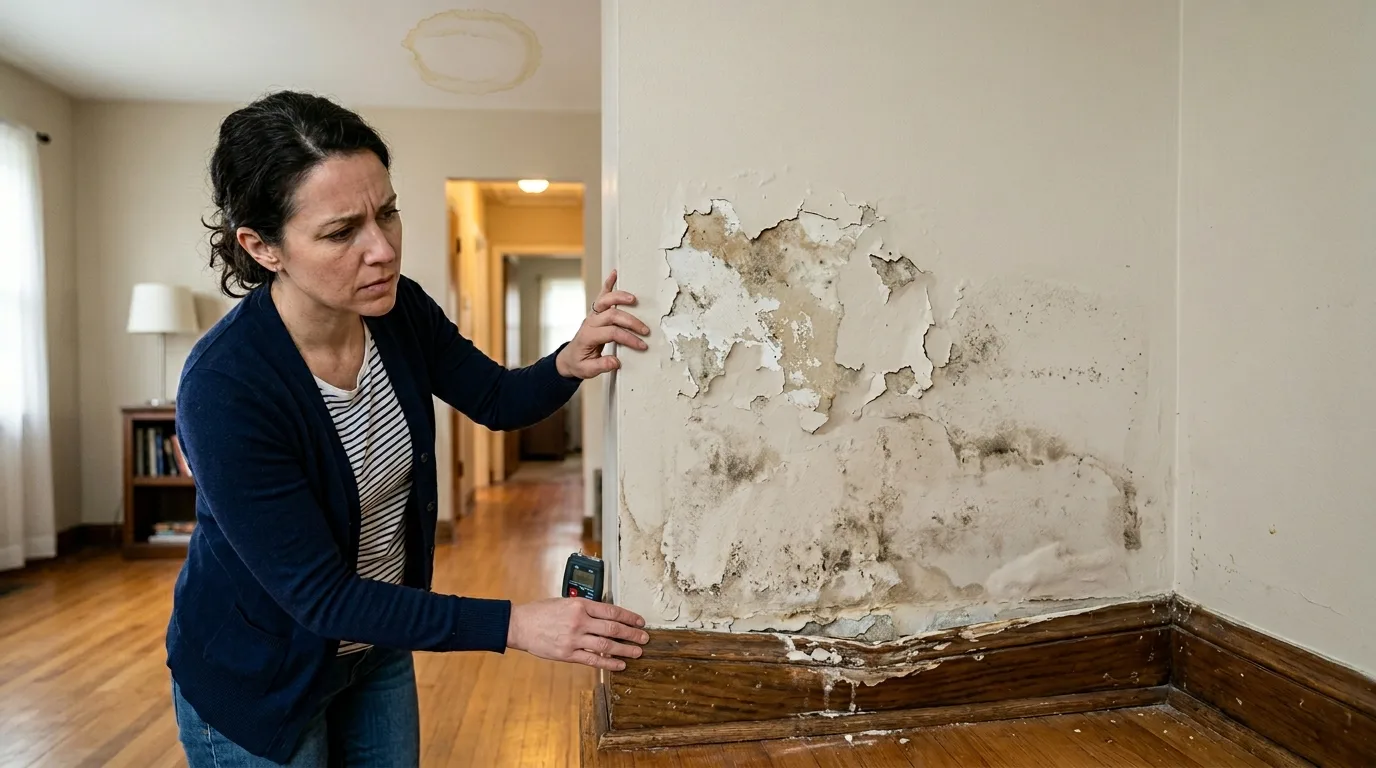
Brown or yellow staining on ceilings or walls that follows the grain of drywall paper indicates water has been present in that area — either from an ongoing leak or a past event that was not fully dried. Bubbling paint means moisture has accumulated between the paint layer and the underlying drywall. Warped or buckled wall surfaces indicate that drywall has absorbed significant water and deformed.
These visual signs are obvious, but the important point is that they are late indicators — by the time paint bubbles, the drywall behind it has been saturated for some time. The actual leak source is typically located above or behind the visible staining, not at the stain itself. Water migrates along framing, vapor barriers, and ceiling assemblies before it surfaces visually.
Stains, Bubbling Paint, or Musty Odors in Watauga?
Call (877) 698-1311 for a professional moisture assessment before it gets worse.
Sign 4: Warm Spots or Soft Spots on Floors
This one is specific to Watauga’s slab-foundation homes. A warm or hot spot on tile or hardwood flooring in an otherwise cool room typically indicates a hot water supply line leak beneath the slab — the warm water heating the concrete and transferring heat to the floor above. This is one of the earliest detectable signs of a slab leak, often appearing before any visible surface water damage.
Soft spots in flooring — areas where hardwood or laminate springs underfoot, or where tile grout has cracked along a pattern that follows floor joists — indicate that the subfloor below has absorbed water and begun to degrade. In slab homes, this indicates prolonged moisture contact from either a slab leak or water intrusion from another source. In homes with crawlspaces (less common in Watauga), soft spots indicate subfloor damage from ground moisture or plumbing failures in the crawlspace.
Sign 5: New Cracking Patterns in Floors, Walls, or Door Frames
Fresh cracking patterns — particularly diagonal cracks from window and door corners, gaps opening between baseboards and floors, or floors that were previously level but now have a slight slope — can indicate differential settlement caused by moisture changes beneath the foundation. This is Tarrant County’s clay soil in action: localized moisture from a slab leak or drainage problem saturates a section of the clay beneath the slab, causing localized swelling that creates a new stress pattern in the foundation above.
This sign is more advanced than the others — by the time cracks appear from differential settlement, the moisture source has typically been present for months. However, new cracks in a previously crack-free home are worth investigating promptly, both because they indicate active soil movement and because they may be creating new water intrusion pathways for future storm events.
What to Do If You Notice These Signs
Any combination of two or more of these signs warrants a professional moisture assessment rather than a wait-and-see approach. Professional moisture mapping with calibrated meters can detect moisture levels in wall cavities, subfloor assemblies, and beneath slabs without destructive investigation — identifying the source and extent of hidden water before you commit to any repair approach.
The cost of a professional assessment is trivial compared to the restoration cost of an undetected problem that runs for another month. Contact Watauga Water Damage Restoration at (877) 698-1311 for a no-obligation assessment — we serve all of Watauga and the surrounding Tarrant County area including North Richland Hills, Haltom City, and Keller.
Frequently Asked Questions
Can I use a store-bought moisture meter to detect hidden water damage?
Consumer moisture meters can detect elevated moisture in accessible surfaces like baseboards and drywall. However, they cannot penetrate wall cavities, concrete slabs, or subfloor assemblies to identify moisture at the source level. Professional equipment includes both surface meters and deep-reading instruments, plus thermal imaging cameras that can identify moisture through temperature differentials. Consumer tools are useful for tracking visible staining, not for ruling out hidden problems.
If I detect a musty smell, does that mean I definitely have mold?
Not necessarily — the musty smell can come from elevated moisture alone before visible mold colonies have established. However, in Watauga’s climate, the window between elevated moisture and active mold growth is short during warm months. Treat a musty smell as a moisture problem requiring investigation regardless of whether visible mold is present.
How much does a professional moisture assessment cost in Watauga?
We provide moisture assessments at no charge as part of a general property evaluation. If you are concerned about a specific area, call us and we will conduct a thorough moisture mapping assessment that documents the extent of any moisture beyond normal levels — at no cost and with no obligation to proceed with any restoration work.
Free Moisture Assessment in Watauga — Call Now
(877) 698-1311 — No-obligation moisture mapping, IICRC certified, serving all of Watauga and Tarrant County.
Related: