How Tarrant County's Expansive Clay Soil Affects Your Plumbing
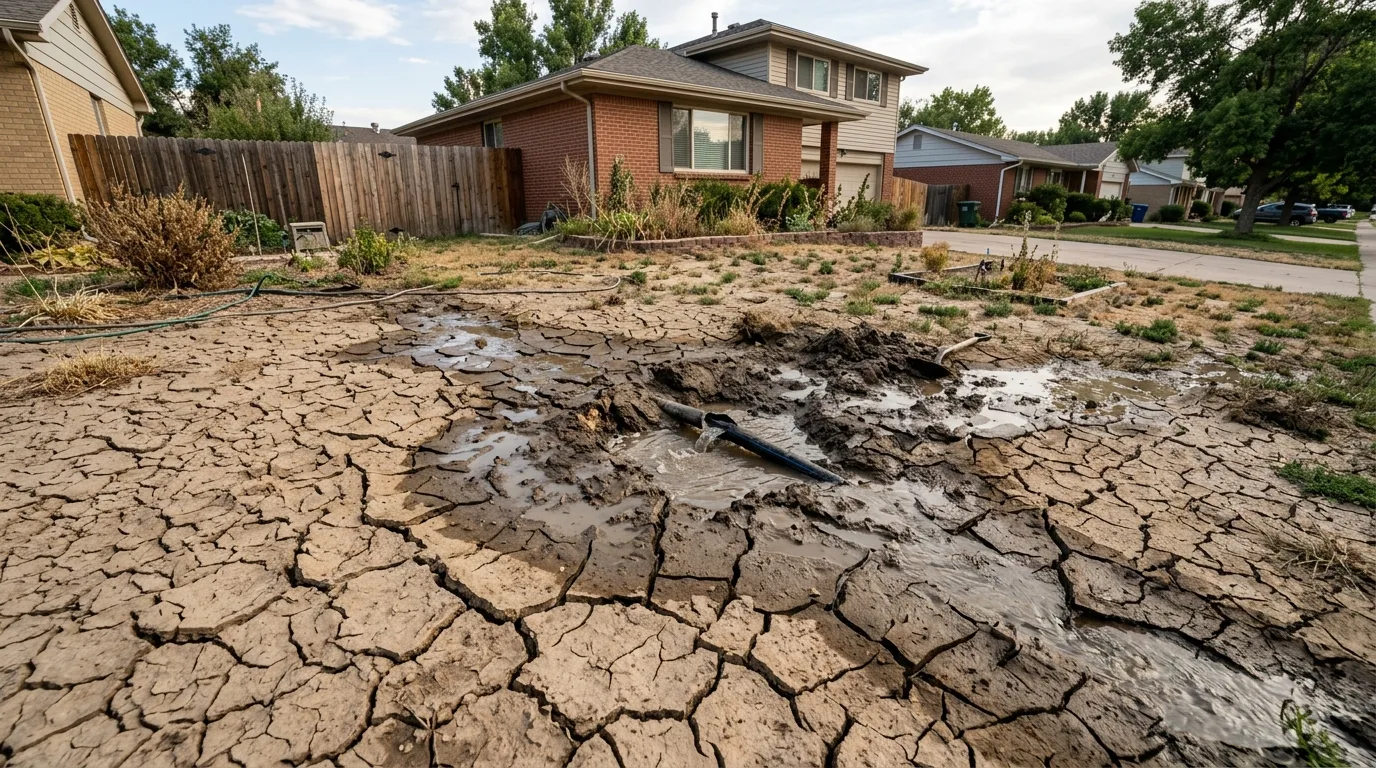
Every year, Watauga homeowners call about unexplained water damage, cracked flooring, and skyrocketing water bills — and in a significant number of cases, the root cause is not the age of the pipes or the weather that week. It is the ground beneath the foundation. Expansive clay soil Tarrant County sits on is a Vertisol class that ranks among the most geologically active soils in the United States, and understanding how it works helps homeowners in Watauga make smarter decisions about maintenance, insurance, and when to call a professional.
Possible Slab Leak from Soil Movement? Call (877) 698-1311
24/7 response. IICRC certified. Expert in Tarrant County clay soil conditions.
What Expansive Clay Soil Actually Does
Vertisol clay soils contain a high concentration of smectite clay minerals — the same type of clay used in industrial seals and waterproofing applications because of their extreme absorption capacity. When these soils absorb water, the mineral crystals expand at the molecular level, causing the bulk soil volume to increase measurably. In Tarrant County, residential lots can see their surface elevation change by 2–4 inches between dry summer conditions and wet spring conditions.
This is not an extreme or unusual event — it happens every year throughout Central Watauga and across the Whispering Hills area. The soil beneath your slab foundation is moving on a seasonal schedule, and everything attached to that slab moves with it: your floors, your walls, your pipe runs.
How Soil Movement Stresses Plumbing Beneath Slabs
Pipes embedded in concrete beneath slab foundations are designed to be stationary — they are rigid materials supported by a rigid slab. When the soil beneath that slab moves, the slab flexes. It is not dramatic flexion visible to the eye, but it is measurable and cumulative. Each cycle of expansion and contraction adds micro-stress to pipe joints, elbows, and any point where the pipe transitions between materials or support conditions.
Galvanized steel pipe — the material in most of Watauga’s 1960s–70s housing stock — corrodes internally over decades as its zinc protective coating depletes. This internal corrosion narrows the water column, creates rough interior surfaces that catch mineral deposits, and weakens the pipe wall. Combine a corroding pipe with 50 years of annual soil movement cycles, and the joint failures and pin-hole leaks that result are not a surprise — they are a predictable outcome of materials responding to conditions.
What soil movement damage looks like in practice:
- Diagonal wall cracks: The most visible sign of differential foundation movement — cracks that run at roughly 45 degrees from window and door corners are a classic soil movement signature.
- Sticking doors and windows: Frame racking from foundation movement causes doors and windows to stick in summer when soils contract and swing freely in winter when soils are wet.
- Separating baseboards and trim: Gaps at the joint between baseboard and floor that open and close seasonally indicate vertical movement of the slab.
- Unexplained water bill increases: The plumbing symptom — a water extraction event that starts slowly and builds, driven by an ongoing slab leak caused by soil stress at a pipe joint.
The Drought-Flood Cycle in Watauga: Why Timing Matters
Watauga’s climate creates particularly severe soil movement cycles. Summer drought conditions — months of temperatures above 90°F with low rainfall — drive the clay to extreme desiccation. The soil cracks visibly, contracts away from foundation edges, and creates voids beneath the slab. Then, when fall rains arrive or a winter freeze event adds moisture to the cold soil, the rehydration happens rapidly.
Homeowners throughout the Residential Subdivisions near Watauga’s schools who have lived in their homes for decades report a familiar pattern: something cracks or a water problem appears in late fall or early winter, after the dry summer has ended and the soil transitions back to moisture. The October-to-February window produces a disproportionate share of slab leak calls in this area because that is when the stress accumulated over a long dry season finally reaches its limit at the weakest pipe joint.
Worried About Your Watauga Foundation or Plumbing?
Get a professional assessment. Call (877) 698-1311 — IICRC certified, 24/7 response.
Foundation vs. Plumbing: Which Problem Comes First?
In most cases, the plumbing fails before the foundation does visible structural damage. A slow slab leak from a joint failure adds moisture to the dry clay beneath the slab — accelerating the hydration cycle in a localized area. This causes localized heaving beneath the leak point, which can create differential settlement within a single slab. Homeowners often notice floor unevenness or a localized crack before they connect the dots to the water bill increase they noticed months earlier.
The reverse can also happen: prolonged drought causes significant foundation settlement, which stresses and breaks pipes beneath the slab. In either sequence, slab leak repair in Watauga and structural drying are required to interrupt the cycle before both problems compound each other.
What Watauga Homeowners Can Do
Understanding the soil condition beneath your home does not mean inevitable water damage — it means informed maintenance. Annual termite inspection companies sometimes notice early foundation movement patterns; plumbers who perform camera inspections of your drain lines can identify root intrusion and pipe degradation before it becomes a failure event. Keeping the soil moisture around your foundation relatively consistent — by maintaining appropriate irrigation during drought rather than letting the soil desiccate completely — reduces the amplitude of seasonal soil movement and extends pipe life.
When a slab leak does occur, the most important action is professional detection and immediate structural drying — stopping the water source and drying the affected area completely before any flooring is replaced. Water trapped beneath new flooring in Tarrant County’s climate will grow mold within days during warm months.
Frequently Asked Questions
Does every Watauga home built on clay soil eventually have plumbing problems?
Not inevitably — but the risk is substantially higher for homes with original galvanized or early copper plumbing built before 1980. Homes that had their plumbing repiped using modern PEX or CPVC materials, even if the foundation and soil conditions are the same, eliminate the corrosion-plus-stress combination that drives most slab leak failures. If your Watauga home still has original plumbing, a professional assessment of the overall pipe condition is a reasonable step at the 40+ year mark.
Is there anything I can do to slow soil movement around my foundation?
Maintaining consistent soil moisture around your foundation perimeter reduces the extreme swing between wet-season swelling and dry-season contraction. A properly programmed irrigation system that runs during drought periods — rather than only during spring and fall — keeps the clay from reaching maximum desiccation. Foundation professionals serving Tarrant County sometimes recommend soaker hose systems for this purpose.
Do newer Watauga homes near the Keller border have the same soil risk?
Same soil — but usually lower plumbing risk because newer construction uses PEX flexible piping that accommodates soil movement better than rigid galvanized or copper. Newer construction also typically has better foundation engineering that accounts for the local soil conditions. The combination of newer materials and better-engineered slabs makes soil-driven plumbing failures much less common in post-1990 Watauga construction.
Plumbing or Water Damage Concern in Watauga? We Can Help.
(877) 698-1311 — IICRC certified, 24/7 emergency response, direct insurance billing.
Related: